What is the Pentathlon?
The Ultraworking Pentathlon is a 16-day competition for driven people who want to finish more of the work that matters.
You’ll complete more of your Most Important Work than you ever thought possible through a combination of competition, camaraderie, and productivity-multiplying support habits.
Whether you’re upgrading business processes, publishing a book, or creating something brand new, the entire Pentathlon experience will help you hit peak performance and forge powerful work and health habits that will stick with you for life.
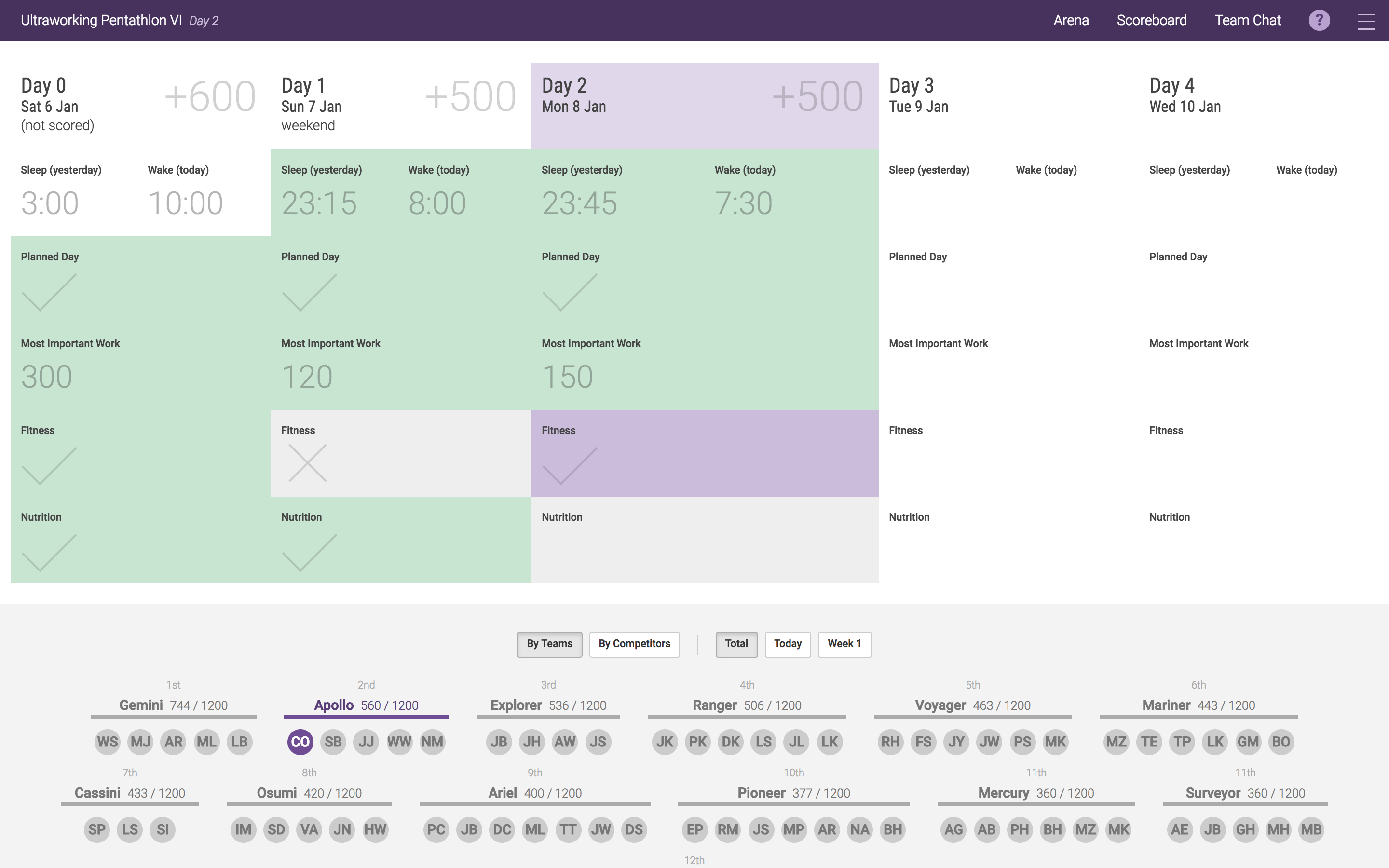
Why do people do a Pentathlon when they want to accomplish more?
The Pentathlon environment can be compared to an intensive martial arts retreat or a foreign language immersion camp.
These environments use a number of known best practices for rapid achievement that we usually don’t have access to in daily life — quick and personal feedback, visible markers of progress, consistency and routine, feedback loops, tradition and morale and momentum, interpersonal dynamics, expert instruction and training, and so on.
It's these elements that we've meticulously included in the design of the Pentathlon.
One example is how we structure the Pentathlon as a competition that has both individual and team aspects.
For whatever reason, people are typically far more willing to break commitments to themselves — whether related to doing one’s most important work, fitness, a good habit like planning each day, or whatever else — than they are to break commitments to a team and other people. That's why we've made the Pentathlon into a team event.
Only a few days into the Pentathlon, I thought I wanted to have some slack — but then I thought, I don’t want to let my teammates down. I need to get back to work and stay consistent in my habits. That helped me keep a perfect score.
— Mony C.
Another example is how tangible progress markers — daily and weekly scoring — helps people progress and realize when things are getting off-track. It’s easy to have habits dissolve for unknown reasons if you can’t see them. But if they’re being tracked, measured, and scored daily, you can make immediate adjustments if happen to you miss your targets for a day.
There’s a lot more to it, but it's not necessary to remember all of the theory. Rather, it's the experience that will bring the most benefit.